Recently added records
Christian Elizabeth Farquharson-Kennedy
Submitted by Alison McCall on 21 April 2011 - 5:03pm
Revised: 14 September 2012 - 8:57pm — Alison McCall
Other names:
Prior to her marriage she was Christian Elizabeth Farquharson.
Dates:
27 February 1870- 16 July 1917
Christian Farquharson was born on 27 Feb 1870, at 57 Spital, Old Aberdeen, one of eight children of Alexander Farquharson and Helen Whalley. She trained as a teacher and taught firstly at Woodside School, Aberdeen and then at Kittybrewster School, Aberdeen. In Nov 1896 she attended a meeting at which she supported a resolution, which was unanimously carried, in favour of socialisation of the means of production, distribution and exchange; emancipation of labour from the domination of capital, and economic equality between the sexes.
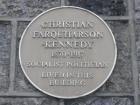
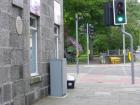
Plaque commemorating Christian Farquharson Kennedy
Submitted by Alison McCall on 21 April 2011 - 5:03pm
Revised: 4 June 2014 - 5:42pm — Alison McCall
Dedicated to:
Inscription:
Christian Farquharson Kennedy
Socialist Politician
1870-1917
Lived Here
Erected by:
Aberdeen City Council
Date:
2006
Location:
Westburn Drive, near the corner with Watson Street.
97 Westburn Drive
Aberdeen
See map: Google Maps
Images:
Plaque commemorating Meredith Brown
Submitted by Alison McCall on 21 April 2011 - 4:54pm
Revised: 26 March 2012 - 8:14am — Alison McCall
Dedicated to:
Inscription:
Meredith Brown 1845-1908
Social Reformer and Founder of the Shaftesbury Institute
Lived in this Building
Erected by:
Aberdeen City Council
Location:
On front wall of building.
78 Dee Street
Aberdeen, AB11 6DS
See map: Google Maps
Meredith Jemima Brown
Submitted by Alison McCall on 21 April 2011 - 4:54pm
Revised: 9 March 2012 - 2:12pm — admin
Dates:
1845-1908
Meredith Brown was the daughter of the Rev David Brown and Catherine Dyce. Born in Glasgow and brought up in Aberdeen, she moved to London at the time of her mother’s death. She became concerned about the lives being led by factory girls in the East End. She and a friend experienced this aspect of life by disguising themselves as factory girls and she subsequently wrote a book based on this experience, Only a Factory Girl. The proceeds of this book allowed her to purchase a house and set up the Shaftesbury Institute. She directed this institution for the remainder of her life.
Jane Durham
Submitted by Rose on 12 April 2011 - 4:24pm
Revised: 21 April 2011 - 4:02pm — admin
Other names:
full name Mary Jane Stow Durham
Dates:
born 26 May 1924, died 1 April 1997
Born into a farming family in Easter Ross, Ross and Cromarty, Jane Durham is best known as a conservationist. She left Easter Ross in 1947 when she married Phil Durham, a Lieutenant Commander in the navy, but returned there in 1957 when her husband contracted polio, and raised three sons. She took part in local campaigns to conserve the heritage and environment of the area, and became extremely knowledgeable about its history, particularly its early Christian history.
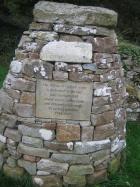
Carved stone plaque dedicated to Jane Durham
Submitted by Rose on 12 April 2011 - 4:20pm
Revised: 8 March 2012 - 4:36pm — admin
Dedicated to:
Inscription:
The Hilton of Cadboll Stone
is dedicated to the late Jane Durham MBE
whose vision, enthusiasm
and determination made
its carving possible
1929-1997
Location:
At the entrance to the site of a replica of the Pictish Hilton of Cadboll stone
Hilton of Cadboll
See map: Google Maps
Images:
Memorial stone with names of ‘famous Fochaberians’
Submitted by Rose on 12 April 2011 - 11:15am
Revised: 20 April 2012 - 10:39am — Rose
Dedicated to:
Inscription:
[includes:]
Ethelreda Adam Baxter 1883–1963
Date:
2002
Material:
stone
Location:
Fochabers memorial garden
Fochabers
See map: Google Maps
Additional information:
The garden in which the memorial appears was created ‘as a tribute to the sons and daughters of this area who have gone out into the world and helped their fellow men’. The garden contains two stones bearing the names of 21 famous Fochaberians, so the inscription is actually more extensive than recorded here.
One of the stones also includes an inscription to 'Jane Maxwell, Duchess of Gordon. Society leader in the theatre of fashion and politics. Raised the Gordon Highlanders Regiment Aberdeen 1794'
More information about the garden can be found on the Famous Fochaberians website.
Ethelreda Baxter
Submitted by Rose on 12 April 2011 - 11:15am
Revised: 19 November 2014 - 2:45pm — admin
Other names:
née Adam, known as Ethel
Dates:
born 22 October 1883, died 16 August 1963
Ethel Baxter was the daughter of a ploughman, Andrew Adam, and his wife Elizabeth Farquar. Born in Roseisle, Moray, Ethel left the family farm to train as a nurse and, in 1914, married William Baxter, one of her patients. William’s parents, George and Margaret Baxter, owned a grocery shop in Fochabers though which they sold Margaret’s jams and marmalades. Seeing an opportunity to expand this business, Ethel persuaded her husband to open a factory in 1916 and while William travelled as a salesman for the business, Ethel managed the factory.
Gravestone of Lady Grisell Baillie
Submitted by Rose on 12 April 2011 - 11:03am
Revised: 10 March 2012 - 12:07pm — admin
Dedicated to:
Inscription:
The Right Honourable LADY GRISELL BAILLIE
wife of GEORGE BAILLIE of Jerviswood, Esq.
eldest daughter
of the Right Honourable PATRICK, Earl of Marchmont;
a pattern to her sex, an honour to her country.
She excelled in the characters of a daughter, a wife, a mother.
While an infant,
at the hazard of her own, she preserved her father’s life;
who, under the rigorous persecution of arbitrary power,
sought refuge in the close confinement of a tomb,
where he was nightly supplied with necessaries, conveyed by her,
with a caution far above her years,
a courage almost above her sex;
a real instance of the so much celebrated Roman charity.
She was a shining example of conjugal affection,
that knew no dissension, felt no decline,
during almost a fifty year’s union;
the dissolution of which she survived from duty, not choice.
Her conduct, as a parent,
was amiable, exemplary, successful,
to a degree not well to be expressed,
without mixing the praises of the dead with those of the living;
who desire that all praise , but of her, should be silent.
At different times she managed the affairs
of her father, her husband, her family, her relations,
with unwearied application, with happy economy,
as distant from avarice as from prodigality.
Christian piety, love of her country,
zeal for her friends, compassion for her enemies,
cheerfulness of spirit, pleasantness of conversation,
dignity of mind,
Good breeding, good humour, good sense,
were the daily ornaments of an unusual life,
protracted by Providence to an uncommon length,
for the benefit of all who fell within the sphere of her benevolence.
Full of years, and of good works,
she died on the 6th day of December 1746,
near the end of her 81st year,
and was buried on her birth-day, the 25th of that month.
Material:
Stone
Location:
Mellerstain House gardens
Gordon, Kelso, TD3 6LG
See map: Google Maps
Lady Grisell Baillie (1665-1746)
Submitted by Rose on 12 April 2011 - 11:03am
Revised: 21 April 2011 - 3:41pm — admin
Title:
Lady
Other names:
née Hume
Dates:
born 25 December 1665, died 6 December 1746
Grisell Baillie was born in Redbraes Castle, Berwickshire, home of her mother and father – Grisell Ker and Sir Patrick Hume. At the age of 11 she was sent by her father to deliver a message to his friend Robert Baillie who was then imprisoned in Edinburgh. It was when on this mission that Grisell met Baillie’s son George, who she later married. This and other acts of heroism are recorded on her memorial.