Recently added records
The eleven victims of the Crook of Devon witch trials in 1662
Submitted by Elizabeth Ritchie on 26 October 2012 - 1:31pm
Revised: 13 November 2012 - 11:51am — admin
Other names:
Agnes Pittendreich, Margaret Hoggin, Christian Grieve, Bessie Henderson, Isabella Rutherford, Robert Wilson, Bessie Neil, Margaret Litster, Janet Paton, Agnes Brugh, Margaret M'Nish, Margaret Young, Agnes Murie
Dates:
d. 1661-1662
These 10 women and 1 man, Agnes Murrie, Bessie Henderson, Isabella Rutherford, Bessie Neil, Margaret Lister, Agnes Brugli, Janet Paton of Crook of Devon, Janet Paton of Kilduff, Janet Brugh, Christian Grieve and Robert Wilson, were tried and executed between April 1661 and October 1662, accused of Witchcraft. 5 men, including William Halliday of Tullibole Castle, Crook of Devon, Perth and Kinross, and his son John presided at the 5 trials and found the accused guilty.
Witches Maze at Tullibole Castle
Submitted by Elizabeth Ritchie on 26 October 2012 - 1:31pm
Revised: 14 November 2012 - 10:28am — admin
Inscription:
[The finished memorial is a circle 33m (100ft) wide and consists of 2,000 beech trees. At the centre of the maze is a one and a half ton elaborate sandstone pillar, with the names of the victims etched on it.]
Erected by:
Lord Moncrieff
Designed by:
Sandstone pillar designed by Gillian Forbes
Date:
Planted in 2003-2012
Material:
Maze of beech hedges with a sandstone pillar in the middle
Location:
Tullibole Castle
Crook of Devon, KY13 0QN
See map: Google Maps
Additional information:
The maze is 100 feet in diameter, designed "also be a attack on the ignorant and superstitious beliefs of the past as well as those in modern day society".
Extracts from the BBC report on the completion of the memorial: "A memorial to 11 people executed for witchcraft in Kinross has been unveiled at the home of those who condemned them. The Witches Maze at Tullibole Castle commemorates the victims of the Crook of Devon witch trials in 1662. The castle was once home to William Halliday and his son John who held court over the 'covens' in the village.
Lord Moncrieff, who now owns Tullibole, commissioned the maze as there is no memorial in Crook of Devon. In 1662 the court sat five times and resulted in the death of 11 suspected witches. Those who survived the trials were taken to a small mound near the current village hall and strangled by the common hangman and their bodies thrown on a fire. Lord Moncreiff commenced on the maze in 2003 ... Lord Moncreiff said: "I dislike public art that has nothing to say and commissioned Gillian [Forbes]because I believe she understands the sensitivity of the task. It is my hope that the memorial will also question our understanding of the past and issues of blame and judgement in modern day society."
http://www.bbc.co.uk/news/uk-scotland-tayside-central-20085045
More information about the memorial is available on the Tullibole Castle's Witches Maze website: http://www.tulbol.demon.co.uk/witches_maze.html
Stained Glass Window in Memory of Elizabeth Berwick
Submitted by Margaret Fergus... on 25 October 2012 - 9:19pm
Revised: 8 September 2026 - 4:18pm — Alison McCall
Dedicated to:
Inscription:
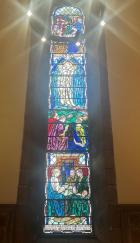
To the Glory of God and in memory of Robert Forgan and his wife, Elisabeth Berwick; the gift of their son James B. Forgan, Chicago, USA
Erected by:
James Berwick Forgan
Designed by:
Douglas Strachan
Date:
1929
Material:
glass and lead
Location:
Martyr's Church
North Street
St Andrews, KY16 9AA
See map: Google Maps
Images:
Elizabeth Berwick
Submitted by Margaret Fergus... on 25 October 2012 - 9:19pm
Revised: 8 January 2015 - 11:53am — admin
Other names:
Mrs Robert Forgan, forename sometimes spelled Elisabeth
Dates:
18.02.1826 - 17.11.1900
Elizabeth was the daughter of James Berwick, Harbourmaster (Anstruther, Pittenweem and St Andrews) and Wilhelmina Menzies Buist, born 18th February (baptized 26th), 1826.
On 16th February 1849, she married Robert Forgan (30.06.1824 โ€“ 1900), son of John Robert Forgan and Janet [Jessie] Paterson (23.08.1805, baptized 08.09.1805), a master golf club manufacturer in St Andrews, Fife..
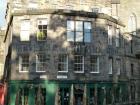
Plaque at Elephant House Cafe to J K Rowling...
Submitted by Margaret Fergus... on 25 October 2012 - 8:50am
Revised: 8 March 2017 - 3:09pm — admin
Dedicated to:
Inscription:
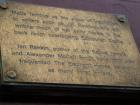
Made famous as the place of inspiration
to writers, such as J.K. Rowling who sat
writing much of her early novels in the
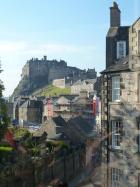
back room overlooking Edinburgh Castle.
Ian Rankin, author of the Rebus novels,
and Alexander McCall-Smith have both also
frequented The Elephant House as well
as many other writers.
Erected by:
The Elephant House Tea & Coffee House and Restaurant
Material:
metal
Location:
on the wall outside The Elephant House to the right of the entrance
21 George IV Bridge
Edinburgh, EH1 1EN
See map: Google Maps
Images:
Charlotte Learmonth
Submitted by Alison McCall on 23 October 2012 - 9:58pm
Revised: 24 October 2012 - 9:19pm — Alison McCall
Other names:
Her maiden name was Charlotte Salter Lyons
Dates:
1839-
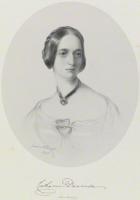
Born in India in 1839, the eldest daughter of Major-General Humphrey Lyons, Charlotte Lyons married Alexander Learmonth of Dean, Edinburgh, in 1859. The couple had seven children. Alexander Learmonth became a Colonel in the 17th Lancers, and, after retiring from the army, M.P. for Colchester. Charlotte Learmonth was widowed in 1887. In 1891 she was living with her daughter Constance in Folkestone, Kent.
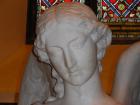
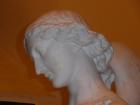
The Angel Font, St Andrew's Cathedral, Inverness
Submitted by Alison McCall on 23 October 2012 - 9:58pm
Dedicated to:
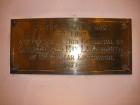
Inscription:
To the Glory of God
The Font
Was placed in this Cathedral by
Col and Mrs Learmonth
of Dean, near Edinburgh
1871.
Erected by:
Col and Mrs Learmonth
Date:
1871
Material:
Marble
Location:
St Andrew's Cathedral
15 Ardross Street
Inverness, IV3 5NS
See map: Google Maps
Images:
Additional information:
The Angel Font is a copy of a font in Copenhagen, but with the face of Charlotte Learmonth.
Dun Deardail, Glen Nevis
Submitted by admin on 23 October 2012 - 3:50pm
Dedicated to:
Inscription:
[none]
Date:
Unknown (see additional information)
Material:
Vitrified stone
Location:
Dun Deardail
See map: Google Maps
Additional information:
This vitrified fort, named for the legendary Deirdre of the Sorrows, may be date from as early as 1000BC, and may have been occupied and possibly rebuilt at several different times.
The site has also been known as Dundbhairdghall, Dun Dearduil and Dun Dearg Suil (Hill of the Red Eyes
Plaque in honour of the Countess of Dunmore
Submitted by Elizabeth Ritchie on 23 October 2012 - 8:45am
Revised: 23 October 2012 - 10:23am — admin
Dedicated to:
Inscription:
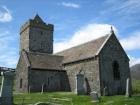
Restored by Catherine Herbert Countess of Dunmore 1873
Date:
1873
Material:
stone
Location:
Above the entrance of St Clement's Church
Rodel
See map: Google Maps
Images:
Catherine Herbert, The Countess of Dunmore
Submitted by Elizabeth Ritchie on 23 October 2012 - 8:45am
Revised: 31 October 2012 - 1:14pm — admin
Title:
Countess
Dates:
d. 1886
Lady Catherine Herbert was the daughter of George Augustus Herbert, 11th Earl of Pembroke and Catherine Woronzow. She married Alexander Edward Murray, 6th Earl of Dunmore, son of George Murray, 5th Earl of Dunmore and Lady Susan Hamilton, on 27 September 1836. She died on 12 February 1886. Her married name became Murray. As a result of her marriage, Lady Catherine Herbert was styled as Countess of Dunmore on 11 November 1836. She promoted Harris tweed as a fashionable cloth for sporting and country wear.
Children:
Lady Constance Euphemia Woronzow Murray d. 16 Mar 1922
Images: