Recently added records
Linsey MacDonald Court, Dunfermline
Submitted by Julia Allison on 19 April 2013 - 9:42pm
Revised: 22 April 2013 - 9:29am — admin
Dedicated to:
Erected by:
the Local Authority of the time
Date:
c. 1980
Location:
Linsey MacDonald Court, Dunfermline
Linsey MacDonald Court
Dunfermline, FIF, KY12 7TS
See map: Google Maps
Memorial plaque
Submitted by Morag Allan Campbell on 17 April 2013 - 9:30am
Revised: 22 April 2013 - 3:18pm — Morag Allan Campbell
Dedicated to:
Inscription:
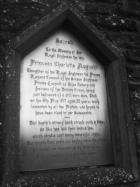
‘Sacred to the memory of her Royal highness the late Princess Charlotte Augusta, Daughter of his Royal highness the Prince Regent, Consort of his Serene highness Prince Leopold of Saxe Coburg and heiress of the British Crown, being just delivered of a still born son, Died on the 6th November 1817 aged 22 years, much lamented by all the Nation, who hoped to have been blessed in her Succession…
‘But death's strong hand struck such a blow
as like has laid their bodies low.
which stroke cost many mournful sighs,
But their souls are happy 'bove the skies
So therefore now our grief must cease
God will in time supply their place.’
Erected by:
Interbild
Date:
1986
Material:
Metal
Location:
Corner of Dundee Road and Victoria Road, Broughty Ferry
See map: Google Maps
Images:
Additional information:
This metal plaque dates back only as far as 1986. In 1901, when the house that stood in these grounds was called Viewfield, the owner Mr Oglivie demolished a small cottage in the grounds and discovered a headstone-shaped stone, bearing the inscription above, hidden within the cottage. The stone was of local sandstone, possibly from the nearby quarries at Carmyllie or Denfind. Viewfield was renamed Burnbank House in the 1920s but demolished in 1986. By this time, the memorial stone was considered beyond preservation, but the local builder who developed the new residential properties in the grounds placed a metal replica in the boundary wall.
Local legend has it that Charlotte and her husband had travelled to his homeland, against the wishes of the Prince Regent and Parliament, to take advantage of better medical facilities there. Their ship was blown off course in a storm, and the couple were forced to take refuge in the Tay Estuary. Charlotte went into labour and subsequently gave birth in a small cottage at West Ferry, where she and the baby died. The locals were sworn to secrecy and the bodies were both taken back to London before the official announcement was made.
However, the circumstances of Princess Charlotte’s death shortly after midnight on November 6th, 1817, at Claremont House, Surrey, are well documented.
Despite the outpouring of grief at her death, there seem to be remarkably few memorials to Princess Charlotte in the United Kingdom. Notable exceptions are her magnificent monument in St George’s Chapel, Windsor Castle, and the recently restored obelisk at Red House Park, West Bromwich.
The origin of the original Broughty Ferry memorial remains a mystery. The shape of the memorial stone, similar to local gravestones, could indicate that the stone was intended to stand outside, perhaps even in a cemetery. A local resident, a Bletchley Park veteran, also proposed that there was a hidden clue encoded in the wording of the verse included in the inscription, suggesting some significance in the use of 'place' rather than 'peace'.
Princess Charlotte Augusta
Submitted by Morag Allan Campbell on 17 April 2013 - 9:25am
Revised: 22 April 2013 - 9:23am — admin
Other names:
Princess of Wales, Princess Leopold of Saxe-Coburg-Saalfeld, Duchess in Saxony
Dates:
Born January 7, 1796, died November 6, 1817
As the only legitimate child of George IV and Caroline of Brunswick, Princess Charlotte Augusta would one day have become queen, had she outlived her father and grandfather, George III. Charlotte was born at Carlton House, London, on 7 January 1796, and died shortly after midnight on November 6th, 1817, at Claremont House, Surrey. Her death in childbirth and the stillbirth of her son shocked the nation and prompted an outpouring of grief. Charlotte had been a much-loved princess, much more popular than her parents, and the whole nation went into mourning.
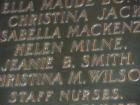
War memorial which includes the name of Helen Milne.
Submitted by Alison McCall on 12 April 2013 - 5:24pm
Revised: 2 October 2013 - 3:37pm — Margaret Fergus...
Dedicated to:
Location:
St Giles Cathedral, Edinburgh
Royal Mile
Edinburgh, EH1 1RE
See map: Google Maps
Images:
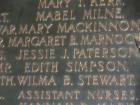
War memorial which includes Margaret B. Marnoch
Submitted by Alison McCall on 12 April 2013 - 5:18pm
Revised: 15 October 2017 - 10:35am — Alison McCall
Dedicated to:
Location:
St Giles Cathedral
Royal Mile
Edinburgh, EH1 1RE
See map: Google Maps
Images:
Additional information:
This is one name amongst many.
Gravestones of Jane Helen and Mary Williamina Findlater
Submitted by Veronica Burbridge on 9 April 2013 - 7:24pm
Revised: 11 April 2013 - 11:32am — admin
Dedicated to:
Inscription:
The grave of Jane Helen Findlater bears the inscription:
Jane Helen Findlater
4 November 1866 – 20 May 1946
Jesus said I am the light of the world. He that followeth me shall not walk in darkness but shall have light of life.’
The gravestone of Mary Williamina bears the inscription:
Mary Williamina Findlater
26th March 1865 – 22nd November 1963
He that dwelleth in love dwelleth in God.
Erected by:
Maclagan family
Location:
Maclagan Family graveyard, Laggan Wood
The Balmuick Road
Comrie
See map: Google Maps
Additional information:
More information about the Maclagan family graveyard is available in the record for the grave of Mary Dalrymple Maclagan.
Jane Helen and Mary Williamina Findlater
Submitted by Veronica Burbridge on 9 April 2013 - 7:22pm
Dates:
1866-1946 and 1865 - 1963
Jane and Mary Findlater were the daughters of Sarah Borthwick, hymn writer, and Eric Findlater, Free Church Minister.
Their mother, Sarah, was the daughter of Sarah Finlay and James Borthwick, insurance manager and grand-daughter of William Finlay, Minister of Polmont. The Findlater sisters were second cousins of David Douglas Maclagan through relations on his mother’s side of the family. They were also related to Mary Maclagan as her sister, Katherine, had married William Finlay, Secretary of the Scottish Equitable Life Assurance Company.
Gravestone of Mary Louisa Maclagan
Submitted by Veronica Burbridge on 9 April 2013 - 7:13pm
Revised: 11 April 2013 - 11:30am — admin
Dedicated to:
Inscription:
To the loved memory of Mary Louisa Maclagan wife of David Douglas Maclagan
7 May 1853 – 29 September 1943
With long life will I satisfy her and shew her my salvation
Rest eternal grant unto her O Lord and let light perpetual shine upon her.
Erected by:
Maclagan family
Material:
stone, wooden cross, wrought iron, yew trees.
Location:
Maclagan Family graveyard, Laggan Wood
The Balmuick Road
Comrie
See map: Google Maps
Additional information:
More information about the Maclagan family graveyard is available in the record for the grave of Mary Dalrymple Maclagan.
Mary Louisa Maclagan
Submitted by Veronica Burbridge on 9 April 2013 - 7:09pm
Revised: 10 April 2013 - 11:00am — admin
Dates:
7 May 1853 – 29 September 1943
Mrs Maclagan was born, Mary Louisa Kerr, on 7th May 1853 in Hamilton, Ontario, Canada. Her father, Archibald Kerr, born in Paisley, Renfrewshire, made his fortune as a merchant in Canada; he was involved in the establishment of the Canada Life Assurance Company. Mary’s mother, Catherine Maclaren was the sister of William Paterson Maclaren, originally from Stirling, who became a member of the business elite of Upper Canada.
Gravestone of Mary Dalrymple Maclagan
Submitted by Veronica Burbridge on 9 April 2013 - 6:32pm
Revised: 10 April 2013 - 10:56am — admin
Dedicated to:
Inscription:
To the blessed memory of Mary Dalrymple Maclagan
November 25 1878 – 7 January 1915
We give thanks to God always for you. 1Thess 1.2
Eternal rest give unto her O Lord and let light perpetual shine upon her.
Erected by:
Maclagan family
Designed by:
Mrs Mary Louisa Maclagan
Date:
1915
Material:
stone; wrought iron fence; yew trees.
Location:
Maclagan Family graveyard, Laggan Wood
The Balmuick Road
Comrie
See map: Google Maps
Additional information:
The Maclagan Family graveyard is an area of 120 square yards, it lies to the east of the road from Milton to Balmuick in the Parish of Monzievaird and Strowan. The purchase included a servitude right of roadway 6 feet wide around the outside of and immediately adjoining the four sides of the ground and a right of access across the rough road from the Balmuick road.
The site for the graveyard was bought from the family’s close friends, the Rev Charles David Robertson Williamson (1853 – 1943), who by the time of Mary’s death in 1915 had sold the Lawers Estate, keeping the lands to the west of the Milton Burn, and was living with his mother, the Hon Selina-Maria Williamson (daughter of the first Lord Tredegar), at Tomperran. Father Williamson was well known in Comrie for his ministry at St Margaret’s R C Church.
A photograph taken in the 1930s shows the enclosed graveyard planted with rose bushes. To the rear of the graveyard are the remains of a small trough, perhaps there for the horses that pulled the wagons carrying the coffins up the steep hill past the Milton to the graveyard. A metal box for gardening tools lies along the east wall.
In the late nineteenth century, the Maclagan family spent the summer months at Comrie House and in 1909 David Douglas and Mary Louisa Maclagan built their own house ‘House of Ross’ on land purchased from Peter Drummond of Drumearn on the west side of Comrie.
The Maclagans referred to the area above the Milton as their ‘Happy Valley;’ and in memory of the family, the fifth hole at the Comrie golf course bears the same name